Saturday, July 20, 2013

Glass in the Garden

Phipps Conservatory and Botanical Gardens, a great steel and glass Victorian greenhouse, has been inviting visitors to explore the beauty and mysteries of plants since 1893. Set amidst one of Pittsburgh's largest greenspaces, Schenley Park, Phipps Conservatory stands as a cultural and architectural centerpiece of the city of Pittsburgh.


In recent decades, Phipps has evolved into one of the region's most vibrant, thriving cultural attractions, bringing fresh perspectives and artists into our historic glasshouse environment. Phipps has also become a strong advocate for advanced green-building practices, sustainable gardening and a new environmental awareness.

During a recent visit to the Phipps Conservatory and Botanical Gardens, the Glass and Ceramics class of Cabell County, WV were able to explore the works of several glass artists including Dale Chihuly in this setting of fantastic flora.  Watch the video below to see some of the images that stood out to one of the visiting teachers and answer the questions that follow.


Phipps Conservatory from Wendy Chapman on Vimeo.


1. Would the glass pieces be more pleasing to the eye in a traditional museum setting or do you feel that the combination of the glass and the plants worked well?  Why or why not?

2. Were you able to pick out all of the glass works easily?

3.  Do you have any sense of what inspired the glass artists to create the pieces shown?

4. Watching the video do you have any favorites or standouts amongst the pieces shown?

Proceed to a website of  possible Chihuly art projects.  Which of the projects looks the most interesting to you?  What materials would be needed for this project?  Have you seen any of Chihuly's work that may have inspired these crafts?


Friday, July 19, 2013

The Glass Menagerie

Over the period of a week, I have seen the glass making process of some of  the remaining glass factories in WV  and Ohio.  I have filmed segments of these processes at the glass blowing factory of  Blenko Glass in Milton, WV,  at the sheet glass factory Paul Wissbach in Paden City, WV, and at the pressed glass factory of Mosser Glass in Cambridge, Ohio.  The segments that I am showing you in the videos below would have been repeated multiples times through out the work day and show processes that were designed to produce the same product every time .  As you watch the videos, compare the processes of each factory and answer these questions.

1. How are these processes from the three different companies alike? How are they different?

2. Why do you think this process has developed in this manner over the many years that each company has been creating glass in their three unique ways.

3.  Do you think this process could be used or is used in the formation of any other products with which you may be familiar?  Explain your answer.

4. Who was Henry Ford and how might he be related to this line of questioning?


Blown Away By Blenko from Wendy Chapman on Vimeo.


Paul Wissbach Glass from Wendy Chapman on Vimeo.


Mossier Glass from Wendy Chapman on Vimeo.

After we discuss your answers the the questions above we will do an activity that will help us to better appreciate the processes that we are observing in the glass manufacturing videos. Please read over the instructions to familiarize yourself with the tasks you may be asked to perform.

Lesson Plan: Students will be split into 4 equally sized groups.  Two groups will be assembly lines, two groups will be individual workers. 
 
Each assembly line will do the following:
1.  Assign a specific task to each worker in each assembly line so that the final product can be made.  A suggestion of how the tasks can be broken down for an assembly line of 8 people is as follows: First two people count out 5 sheets of paper each (one counts out colored paper and the other counts out plain paper), the third arranges the stack of papers to be alternating in color (plain, colored, plain, colored… etc.), the fourth lines up papers into a nice stack, fifth measures out 1 meter long ribbon, sixth ties ribbon around stack of paper with knot, seventh ties nice bow using the extra ribbon, eighth person takes stack and arranges it on table and keeps count of how many stacks have been made.
2.   The tasks can be distributed among more or fewer individuals depending on how many people are in each assembly line.
3.   Each assembly line will line up with the proper materials at the correct positions on the assembly line.
4.   When the individual workers are ready also, the teacher will tell everyone to begin.


Wednesday, July 17, 2013

The Dish on Homer Laughlin's Fiesta

The Glass and Ceramics class was privileged to explore the Homer Laughlin China Company today and witnessed some of the practices that has made this WV company a household name.  Watch the video below and note the formidable history that allowed the formation of a product that captured the attention and devotion of generations of people as they set their tables with this famous dinnerware.

The foresight of its leaders have allowed this company to continue to grow as they expanded their china production into the commercial restaurant arena.  Many restaurants that we all frequent such as Steak and Shake, Applebees, PF Changs, and many others use Homer Laughlin dinnerware.  So when life is good and people are eating out chances are that they are eating off of plates made here in WV. However when the economy dictates that people can't afford to eat out as often and they must entertain themselves and others at home, then people look to home improvement to make their home time a more pleasurable experience.  Not able to afford a costly kitchen remodel some folks would opt to replace their dinnerware to create a new atmosphere.  Its a win-win for Homer Laughlin.

Your first assignment is to survey 20 people with the following questions? We will discuss results in class.
1. Have you ever heard of Homer Laughlin?
2. Have you ever heard of Fiesta dinnerware?
3. Do you own any Fiesta dinnerware?
4. Have you ever known anyone who owns or has owned any Fiesta dinnerware?
5. Where could you buy Fiesta dinnerware locally?

Your second assignment is long term. The next time that you are eating out with your family; check the bottom of your plate to see if the name Homer Laughlin is there indicating that you are eating off of WV made china. A chart will be posted and we will add restaurants as they are discovered.


Tuesday, July 16, 2013

Recycling Glass

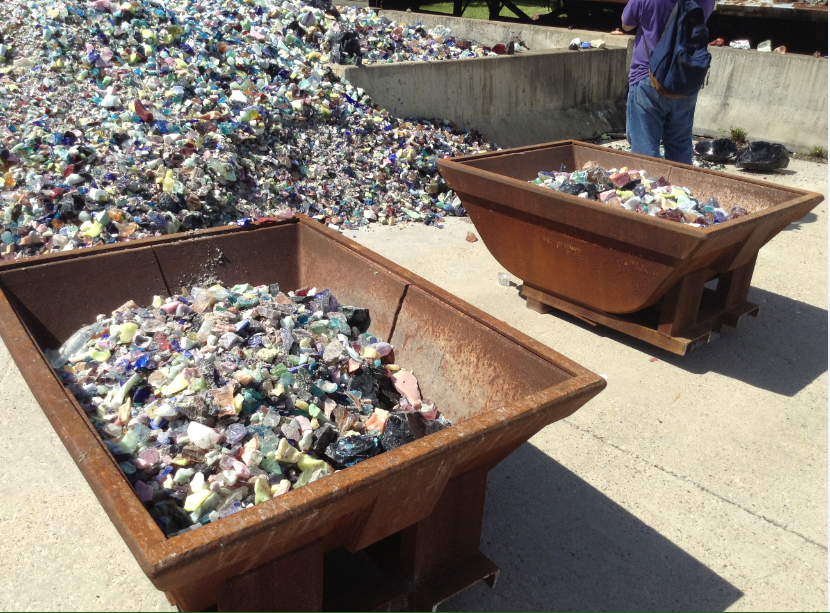
Gabbert Industries is a factory that collects cullet which is scrap glass that will later be used in the manufacturing of new glass.  Below you see several pictures of the piles of cullet that accumulate at the factory.  The glass must be picked up and sorted based on size and or color and then it is resold to glass manufacturers to be used to make more glass. 
Gabbert Cullet


Gabbert Cullet
 
Gabbert collects cullet from many of the local manufacturers of glass including Fenton and Blenko glass.  In turn other companies like Marble King may buy the cullet from Gabbert for use in their own glass products. 
Blenko Cullet


Marble King Cullet

Marble King Marbles


This continuous recycling of glass is very important to the environment for a variety of reasons.  Please go the following website to watch two videos that will help develop your understanding of how recycling of glass is very important to our environment.

http://www.captaincullet.com/recycling_animations.html

After watching the animations design a poster on a clean sheet of white copy paper incorporating Captain Cullet and/or Little Gob that could be used to persuade the general public that recycling glass is an important consideration in our effort to protect the earth.  Your poster should clearly support some of the reasons that Captain Cullet and Little Gob present in the videos.

Oglebay Glass Museum


In Wheeling, WV there is a great resort area known as Oglebay Park.  Within this resort they have managed to collect a history of glass that reflects the growth and changes in this industry through out the years.  The video below shows a  small selection of the artifacts that they have accumulated.  The other image is a scavenger hunt that would normally take place as you move through the museum examining the glass collection.  Use the Scavenger Hunt Guide as you view the video and try to match the images with the descriptions.  All of the images can be seen in the glass museum but not all of the images are contained within the scavenger hunt. Good Luck!!

Oglebay Glass Museum from Wendy Chapman on Vimeo.

Monday, July 15, 2013

Analyzing Glass Color

The following image is part of a presentation at the Fenton Glass Factory in Ohio.  The image describes the basic ingredients of fabricated glass and lists the chemicals that are needed to produce specific glass colors.  Using this image and the lists of batch chemicals listed below, choose a piece of glass to bring to class and try and determine the chemical makeup of the batch recipe from which your glass may have been derived.  Be prepared to share with the class.


Colors                                                                     Chemicals
Willow Green (Light Green)                                  Copper + Potassium Bichromate
Blue Topaz      (Light Blue)                                    Copper + Powder Blue (Pigment)
Rose Milk        ( Light Pink)                                   Selenium + Erbium Oxide + Neodymium Oxide
Black                                                                       Potassium Bichromate + Cobalt Oxide
Violet               (Light Purple)                                Manganese + Powder Blue (Pigment)
Ruby                 (Red)                                             Cadmium Oxide + Selenium
Sunset              ( Light Orange)                              Selenium
Burmese           (Cream and Brownish)                  Depleted Uranium
Milk                  (White)                                          Fluor


Suppose you have a piece of glass that does not clearly contain one of the major colorants listed.  Using the chart above hypothesize what you believe will be the chemicals contained in the glass.
Be prepared to share with the class.

Natural verses Fabricated Natural Glass

Read through the following experiments in preparation to execute in class.  Answer the following  questions.

1. There are four types of natural glass described below.  What do the four types have in common with regards to their formation?

2. Why is quartz not considered a type of natural glass?

3. What are the independent and dependent variables for each Experiments A, B, and C?

4. What are some of the controls that had to be maintained in each of the Experiments A, B, and C?


 Natural verses Fabricated Glass

Types of Natural Glass
Fulgurite – Glass resulting from a strike in a mass of sand that has the right combination of minerals. This forms brittle, glassy tubes that preserve the shape of the lightening as it travels through sand.

Quartz – This glass-like rock crystal has the transparency of glass, but its crystalline structure prevents it from fully fitting the definition of glass.
1 A simplified definition of glass describes it as a material that solidifies from a molten state without forming crystals.


Obsidian – Glass formed due to the intense heat of a volcano.


Tektite – Glass that forms as molten blobs of earth are tossed into the air when a meteorite hits the earth.


Euplectella – A glass sponge found in the western Pacific Ocean near the Phillipines with a hollow-cylindrical skeleton made from silica.


Glass occurs in nature when sand or stone endures extreme heat and then cools rapidly. Man used natural glass to create tools and jewelry, but was not able to fully take advantage of the beneficial properties of glass till he could make it himself. After witnessing how glass formed in nature, man began to modify glass recipes that create the many glass objects we depend on everyday.

Fabricating Glass
The glass that surrounds us in our every day lives, from bottles to windows, is commonly made from silica (silicon dioxide, SiO2), also known as sand. When silica is cooled from a molten state it begins to behave like a solid, though it technically retains its status as a liquid. The structure of the molecules of glass does not change as it goes from a hot liquid state to a cold rigid one. The temperature at which silica begins to act like a solid, known as the transition temperature, is relatively high. Pure silica creates a very strong glass with great chemical durability, but the cost of manufacturing a glass that requires such a high melting temperature prevents its commercial use. The solution for this problem can be found in the addition of modifiers known as flux. Fluxing agents, such as alkali or alkaline earth oxides, lower the temperature at which the pure silica melts by disrupting the network connectivity. As modifiers lower the transition temperature, they also decrease the chemical durability and make the formation of glass more difficult. This requires a glass engineer to balance cost and quality when creating a recipe that best fits the needs of the glass manufacturer.
Understanding Fabrication through Candy Making
The methods used for making candy demonstrate many of the same principles as in the formation of glass. Sugar replaces silica as the glass former and the use of water mimics alkali as a modifier. Sugar (sucrose) has a melting temperature of 186 ºC while water has a melting temperature of 0ºC. Comparably, silicon dioxide has a melting temperature of 1723ºC while alkali has a melting temperature of 1275ºC. The experiments below use a) sugar alone, b) sugar and water, c) sugar, corn syrup and water.

Vocabulary
Transition temperature
Flux
Fiber draw
Viscosity

Objective
After this experiment, the student should be able to understand these basic principles of glass science and technology:
1. If a pure melt is cooled slowly enough, it forms a single crystal, while cooling quickly produces a polycrystalline solid. Crystal formation can be completely suppressed if the cooling rate is sufficiently increased, thus creating glass.
2. Impurities, mechanical agitation, bubbles and other factors can create crystals. The addition of a modifier decreases the ability of the melt to form glass.
3. The number of ingredients may improve the ability of a melt to form glass.
4. Modifiers overall weaken the glass.
5. The viscosity of a melt can be controlled by varying the temperature, which makes it possible to control the drawing of glass fibers.

Materials
Hotplate or electric stovetop
1 one-quart stainless steel pan
12 metal tablespoons
1 laboratory balance
1 metal tray to hold hot candies (up to ~ 175ºC/350ºF)
1 laboratory of good quality thermometer that reads up to ~ 205ºC or 400ºF
5 pounds of granulated cane sugar
16 oz. bottle of corn syrup
Drinking water
20 molds for casting. (The metal containers from Tea Light candles work well or small cookie cutters)
4 eight oz. glasses
Crystal candy, available in clumps of large, colorless crystals

Experiment A- Pure sugar.
1. Place molds on metal tray.
2. Put 410 g sugar in the pan and gradually heat on hotplate or electric stovetop at low-medium temperature. Insert thermometer and monitor the temperature of sugar.
Stir sugar with spoon in order to maintain uniform temperature throughout. Note: keep thermometer bulb in the middle of sugar, but away from the bottom of the pan.
3. Continue to stir at a rate that best mixes solid and molten parts. Continue heating and stirring until all the sugar has melted. The stirring speed should be such that solid and molten parts mix together. Record the temperature at which the sugar melts.
4. At this point, stop stirring and prevent the temperature from increasing. Temperature increase would cause excessive browning and the formation of bubbles, symptoms of the decomposition of sugar.
5. Put one tablespoon of molten sugar in mold (sample #A1) and three tablespoons in a different mold (sample #A2). Note: molds can be easily marked and kept track of with permanent marker.
6. Record the physical appearance of the samples as they cool to room temperature. Make observations regarding transparency, presence of small white crystals and/or bubbles, and solid or liquid state.
7. A fiber draw can be created by slowly pull a spoon out of the melted sugar. Record a prediction for which temperature the fiber draw will be at the height of its ability.
8. Turn the hotplate off. Make several fiber draws, all the while noting the temperature. Continue this process, as the temperature decreases and the sugar becomes more solid, until a fiber draw is no longer possible. Note the temperature at which the fiber draw reached its maximum ability.
9. Compare the appearance of samples #A1 and #A2 with that of crystal candy that is also made of pure sugar.

Experiment B- Sugar and water modifier.
1. Put 410 g sugar and 100 g water in the pan and begin heating while stirring the melt. Monitor increasing temperature as sugar dissolves. Record the temperature at which all the sugar dissolves.
2. Continue to heat and stir. Record the temperature at which the syrup begins to boil.
3. Cast candy from the syrup (sample #B1). Record the physical appearance of the samples as they cool to room temperature. Make observations regarding transparency, presence of small white crystals and/or bubbles, solid or liquid state. If the sample remains fluid once it has reached room temperature, note its relative viscosity.
4. Continue to stir and boil the remaining syrup until the temperature increases by 5. °C (or 10 °F) If solid sugar deposits on sides, scrape and stir it into the liquid. Cast candy from this more concentrated syrup (sample #B2). Make a note of the physical appearance as in step three of experiment B.
5. Repeat step 4, casting a new candy for each 5 °C (or 10 °F) increment in temperature (sample #B3, #B4, … etc.). Continue until the temperature reaches 170 °C (338 °F).
Be sure to use a clean spoon to cast each new sample.

Experiment B(a)- Sugar and water; without stirring.
1. Repeat all the steps of Experiment B, except this time do not stir the solution after the sugar has settled at the bottom of the pan (at 200 F). Try to cast the samples (#B1(a), #B2(a), #B3(a),… etc.) when the melt is at the same temperature as in Experiment B.
2. Record the changes in samples as they cool to room temperature, making special note of any differences compared to the corresponding B samples.

Experiment C- Sugar, corn syrup and water.
1. Repeat Experiment B(a) using 240 g corn syrup, 410 g sugar and 100 g water in a clean pan.
Testing: Effect of processing conditions on the properties of candies.
Hardness or Chewy character. The samples should have a wide range of hardness from brittle solid to a watery liquid. To make a comparison of this property, use a paper clip. Open up a paper clip to have one sharp end and keep the rest bent. For the solid samples, insert the sharp end with consistent force into each sample and compare the size of the dents created. For liquid samples, use the bent end of the paper clip. Dip it into the liquid and take it out, noting the relative force needed.
Durability in water. For one temperature, select a sample from each of the A, B, B(a) and C experiments (i.e. the cast from the melt at 150 °C or 302 °F). Weigh (still in mold) on laboratory balance and place them in separate 8-oz. glasses with 200 g tap water. (Note: all the water should be at the same temperature). Drain the water out after 1 hour. During this time, avoid disturbing the sample and water. Take the samples out, dry and weigh them again. Calculate the respective weight loss due to the water dissolving the sample. Each sample has equal surface area exposure to the water, thus making the weight loss inversely proportional to the durability; the greater the weight loss, the lower the sample’s durability.

Hint for recording information onto a table: When possible, assign relative grades of 1 through 5 to non-quantative information. For example, in a column for transparency, write 1 for an opaque and 5 for a completely transparent sample.